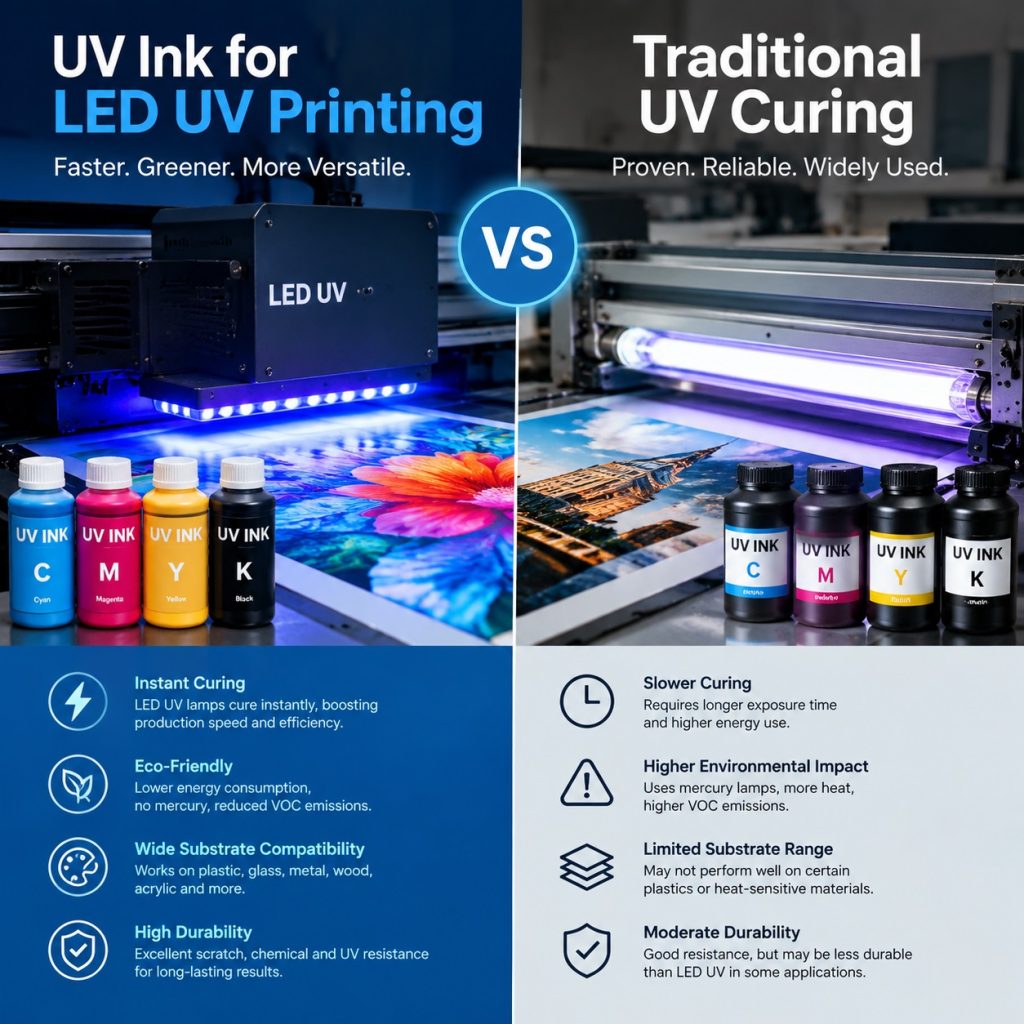
 The curing lamp is not a lightbulb you swap like a burnt-out bulb. It is a chemical reactor, a speed limiter, and a hidden line item in your cost per print. That is why the choice between LED UV printing and traditional UV curing starts with the ink, not the lamp.
A UV ink is a package: oligomers, monomers, pigments, additives, and photoinitiators. The photoinitiators are the part that wake up when light hits them. Change the light source, and you change which photoinitiators actually work. LED UV curing usually fires around a narrow band, often 385 nm or 395 nm. Traditional UV curing from mercury or metal halide lamps throws a broad spectrum, from deep UV into visible light, plus a lot of infrared heat. Same word, UV, very different dinner invitation for the chemistry.
That difference matters before you sign a purchase order.
LED UV printing has obvious curb appeal. Lamps are instant on and instant off, so you are not waiting for warm-up or letting a bulb idle. They run cooler, which helps with thin films, heat-sensitive substrates, and some packaging stocks. They last far longer than mercury bulbs, and they avoid the ozone and mercury disposal headaches that come with traditional UV. For a shop trying to cut energy costs and simplify maintenance, that is a strong pitch.
But the ink has to match the lamp. LED UV inks are formulated with photoinitiators tuned to the LED wavelength. Put a traditional UV ink under an LED lamp, and you may get a sticky surface, poor through-cure, or adhesion that fails after a fold or a tape test. Put an LED ink under a traditional mercury lamp, and you may over-cure or waste chemistry. Some inks are hybrid and can run under both, but hybrids are a compromise, not a magic bullet.
Traditional UV curing still owns several corners of the market. Mercury lamps deliver high peak intensity and a broad spectrum, which can be an advantage for thick ink films, highly pigmented whites, dark blacks, and high-speed production where every millisecond counts. The broad spectrum can also reach deeper into the film and handle formulations that LED wavelengths struggle to cure. If your work is heavy coverage, high opacity, or unusual specialty coatings, traditional UV may still be the safer production horse.
The buyer’s first question is not “Which is newer?” It is “What am I printing, on what, at what speed, and with what performance requirement?” A narrow-web label printer running heat-sensitive film at moderate speed may find LED UV a clear win. A wide-format shop laying down thick white on rigid boards at high speed may find traditional UV more forgiving. A packaging printer with food-contact concerns needs to look beyond curing speed and examine migration, low-migration ink systems, and whether the chosen chemistry is approved for the application.
Then there is the money. LED UV often wins on electricity, lamp life, and maintenance. Traditional UV often wins on ink cost per kilo and the sheer maturity of the supply chain. But the real number is total cost per sellable print. Add up energy, bulb replacement, reflector cleaning, ozone extraction, chillers, downtime, scrap rate, and the labor spent chasing adhesion problems. A cheaper ink that forces you to slow the press or reject more jobs is not cheaper. A higher-priced LED ink that lets you run cooler, faster, and with fewer lamp changes can pay for itself in a few months.
Do not let a sales sheet decide this for you. Ask for a cure test on your substrate, with your artwork, at your target speed. Check surface cure with a thumb twist or MEK rub. Check through-cure with a cross-hatch adhesion test, a fold, a crease, and a tape pull. If the application demands it, ask for migration data and regulatory documentation. Run the same test under both lamp technologies if you can. The ink that looks best in a brochure may not be the one that survives a real shift.
Also look at the press environment. LED UV modules are smaller and cooler, which can open up machine design options. Traditional UV lamps need warm-up, shutters, exhaust, and more heat management. That extra hardware costs space and service time. If you already have a traditional UV line that is running well, switching to LED may mean new ink, new lamp modules, new maintenance routines, and a learning curve. The upgrade is not just a bulb swap. It is a system change.
For buyers, the smart move is to separate the lamp from the ink, then reunite them in a trial. Tell your ink supplier what lamp, what wavelength, what speed, and what substrate. Tell your lamp supplier what ink chemistry you plan to run. Make them talk to each other. The shops that get this right treat UV curing as a partnership between chemistry and light, not as a battle between old and new.
If you are specifying a new press, ask for a side-by-side cure trial before the invoice. If you are switching an existing line, ask for a migration and adhesion plan, not just a price per kilogram. If you are a brand owner approving packaging, ask your converter which ink and curing system will be used, and whether the cure window is robust enough for the full run. Those questions protect the print, the schedule, and the bottom line.
LED UV is not automatically better. Traditional UV is not automatically obsolete. The right choice is the ink and curing combination that cures completely, adheres reliably, meets the regulatory bar, and hits your cost target on the substrates you actually run. Everything else is just lamp talk.